

AC Coil Cleaning: DIY vs Professional
DIY AC coil cleaning effectively removes debris and dust buildup from your coils. Then, you can safely clean light dust off your outdoor unit condenser, rinse the unit with a garden hose, and flush your condensate drain line. These work wonders in Las Cruces, where desert dust builds up fast.
But for deep evaporator coil cleaning, refrigerant-related issues, and heavily caked coils, get a pro. Doing these yourself risks damaging the fins, using the wrong cleaner, or missing a bigger problem.
In this guide, we will discuss why you should clean your AC coils, when and how to DIY, plus when to call for backup. Call Air Control Services at (575) 567-2608 for professional AC maintenance services. We’re available 24/7.
What Is an AC Coil?
An AC coil is a system of two copper or aluminium tubes or coils wrapped in thin metal fins. Those fins help transfer heat quickly and efficiently.
The evaporator coil is in the part of the air conditioning unit inside the home. When warm air inside a room blows over it, the refrigerant inside it absorbs the heat. Then it passes it to the condenser coil in the outside part of the unit. It releases the captured heat outside.
If either coil is coated with dust, dirt, or grime, heat transfer slows. In turn, the AC works harder, runs longer, and costs more to operate.
Why Should You Regularly Clean Your AC Coil in Las Cruces?
Regularly cleaning your AC coils minimizes dirt buildup on your unit. This is especially important in Las Cruces, which sits in the Chihuahuan Desert. Dust, sand, and airborne debris are constant. Coil cleaning keeps your system running the way it should all summer long.
Here are other reasons why:
- Lower energy bills: Dirty coils force your AC to work harder, using up to 40% more energy than a clean one.
- Better cooling performance: Clean coils transfer heat efficiently. Your home reaches the set temperature faster and stays there.
- Longer equipment life: Overworked components wear out faster.
- Healthier indoor air: Dust, mold, and debris on coils can get pushed into your home’s air.
Signs Your AC Coils Are Dirty
If you notice any of the following signs, dirty coils may be the cause.
- Your home isn’t cooling the way it used to. Rooms feel warmer than your thermostat setting.
- Energy bills are rising without a clear reason.
- Ice is forming on the indoor unit or refrigerant lines. Restricted airflow from dirty coils causes the coil to freeze.
- The air coming from your vents feels weak.
- There’s a musty, stale smell coming from your vents.
- Your AC runs constantly but can’t keep up.
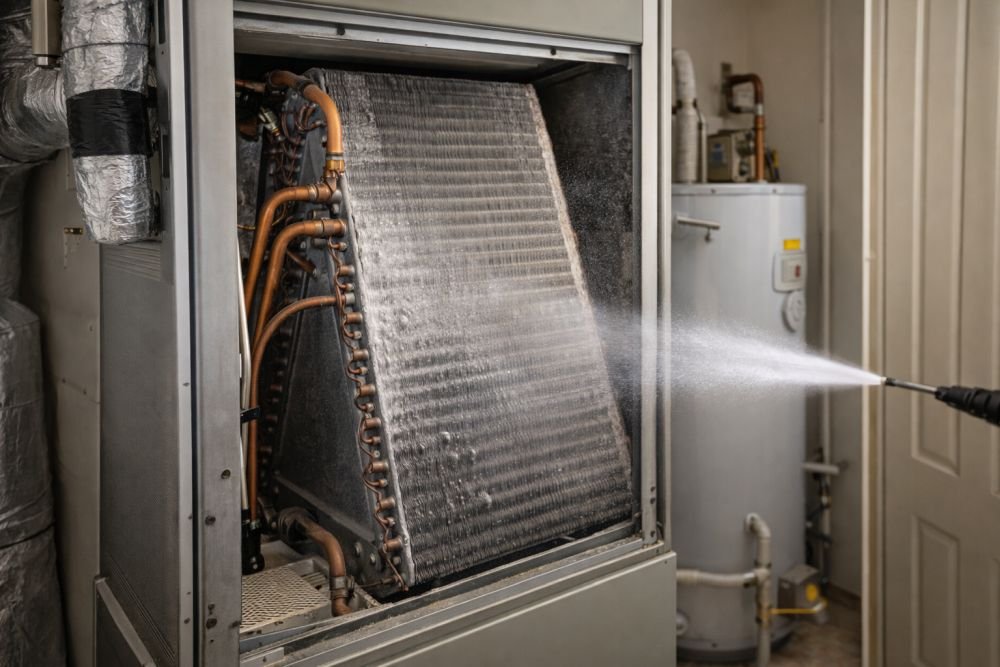
DIY Air Conditioner Coil Cleaning
Here are some DIY AC coil cooling tasks you can handle at home, and how to do each one correctly.
How to Clean Indoor Evaporator Coils
Average time: 30 to 45 minutes
Equipment:
- Screwdriver or drill
- Soft-bristle or coil brush
- No-rinse foaming evaporator coil cleaner (available at hardware stores)
- Protective gloves
- Safety glasses
- Shop vac (optional)
Step-by-step process:
- Turn off your AC at the thermostat and at the breaker: Don’t skip this step. The coil fins are sharp, and the system must be fully powered off.
- Find the access panel on your indoor air handler. A few screws often secure it. Remove them and set the panel aside.
- Inspect the coil: Look for visible dust, pet hair, or grime coating the fins. Use a flashlight, if needed.
- Use a soft brush to gently loosen surface dust: Brush along the fin, never across it. Brushing across can bend the fins.
- Spray the coil evenly with no-rinse foaming ac coil cleaner: Wear gloves because the cleaner is acidic. Let the foam sit for 5 to 10 minutes.
- Allow the foam to drip into the condensate drain pan below: The cleaner will carry dirt with it as it runs off. No rinsing needed.
- Check the condensate pan and drain line: Clear any standing water or debris. Flush the drain line with a mix of water and white vinegar.
- Replace the access panel and restore power: Turn the air conditioning system back on at the breaker, then turn the thermostat back on.
Problems this avoids: Reduced airflow, frozen coils, musty odors, and rising energy bills.
How to Clean Outdoor Condenser Coils
Average time: 20 to 40 minutes
Equipment:
- Screwdriver or drill
- Garden hose with adjustable nozzle
- Outdoor condenser cleaner (or mild dish soap in a bottle with a spray nozzle)
- Soft-bristle brush
- Protective gloves and safety glasses
Step-by-step process:
- Shut off the AC unit’s power: Do not skip this step.
- Remove any visible debris: Look around the unit and on top of it. They can be dust, weeds, and desert debris.
- Remove the top panel or cage: Use your screwdriver. You can skip this step for a light maintenance rinse.
- Use a soft brush attachment to remove loose dirt and debris gently: Brush along the fins, not across.
- Apply condenser coil cleaner to the fins: Use a product labeled for outdoor condenser coils, or mold dish soap. Note that it is not the same formula as the indoor evaporator cleaner.
- Let the cleaner soak: Let it sit for 5 to 10 minutes.
- Rinse thoroughly with a garden hose: Set the nozzle to a gentle, wide spray. Not a jet. Spray from the inside out to push debris outward.
- Replace any panels, restore power, and restart the system.
Problems this avoids: Overheating, inefficient heat release, compressor strain, and short cycling.
How to Straighten AC Fins at Home
You can straighten AC fins at home if the damage is minor. Bent fins reduce airflow through both coils. You can straighten them yourself with a fin comb.
Equipment needed: Fin comb (sold at hardware stores and sized to your coil’s fin spacing)
Step-by-step process:
- Turn off all power to the unit: Don’t skip this step.
- Put on gloves: Fin edges are sharp and can easily cut skin.
- Select the correct size on your fin comb: Most combs have multiple sizes on one tool.
- Gently slide the comb through bent sections: Work slowly and steadily along the fins.
- Don’t force the comb: If a section is severely crushed or the coil is damaged underneath, stop. Call an AC technician.
Problems this avoids: Restricted airflow, reduced cooling efficiency, and short cycling:
How to Clean the Condensate Drain Line
Average time: 10 to 15 minutes
Equipment needed: White vinegar or diluted bleach, funnel or turkey baster, small brush
Step-by-step process:
- Find the condensate drain line: It’s a PVC pipe that exits near your indoor air handler, usually draining outside or into a floor drain pipe.
- Locate the drain line access point: It typically has a T-shaped vent cap you can remove.
- Pour a cup of white vinegar into the access point: This breaks down algae and mold without damaging the pipe.
- Let it sit: Allow about 30 minutes to pass
- Flush: Then, flush with clean water.
- Repeat: You can do this every month during Las Cruces summers when the system runs daily.
Problems this avoids: Drain line clogs, standing water in the pan, water damage near the air handler, and air conditioning system shutdowns.
Pros and Cons of DIY AC Coil Cleaning
While DIY air conditioner coil cleaning is fast and immediate, we don’t recommend it all the time. Here are the pros and cons of cleaning AC coils yourself.
Pros:
- It saves money: You avoid a service call fee for basic surface cleaning.
- You can do it on your schedule: No waiting for an appointment.
- It builds good maintenance habits: Regular light cleaning extends the time between professional visits.
- It works for light dust buildup: Surface cleaning on accessible coils is something most homeowners can handle safely.
Cons:
- You can damage the fins easily: Coil fins bend with very little force.
- Indoor coils are hard to access: Many evaporator coils are deep inside the air handler and not easily reached.
- You can’t address refrigerant issues: If the coil problem is tied to low refrigerant, no amount of cleaning will fix it.
- Wrong cleaners cause corrosion: Using the wrong product on the wrong coil type can permanently damage your system.
- Deep cleaning requires removal: A severely dirty coil must be removed for proper cleaning, which is best left to a pro.
Professional Air Conditioner Coil Cleaning
A professional coil cleaning goes much deeper than DIY tactics. Technicians use commercial-grade tools to remove heavy buildup, check refrigerant levels, and inspect parts not visible from the outside.
A technician removes the access panels, inspects both coils, and cleans them using professional-strength cleaning agents. They also check the condensate drain, inspect coil fins, test refrigerant pressures, and look for early signs of corrosion or leaks.
Schedule a professional cleaning if your system is struggling to keep up, if you’ve noticed ice on the coil, or if DIY cleaning didn’t resolve the issue. Also, get one if your system hasn’t been serviced in over a year.
In Las Cruces, you should get a professional air conditioner coil cleaning at least once per year. It is better to book one in early spring, before the summer heat arrives.
Pros and Cons of Professional AC Coil Cleaning
While a professional cleaning is ideal, sometimes you can just handle the work and save some money. Here are the pros and cons of professional air conditioner coil cleaning.
Pros:
- It is thorough: Technicians clean areas you simply can’t reach at home. Also, heavily caked coils must be removed and chemically soaked.
- It is safe: Professionals handle sharp fins, acidic cleaners, and electrical components correctly.
- It discovers other problems early: A tech will spot refrigerant leaks, failing capacitors, or duct issues.
- It protects your warranty: Many manufacturer warranties require professional maintenance records.
Cons:
- It costs more upfront: A professional cleaning visit costs more than a can of ac coil cleaner.
- You need to schedule an appointment: Sometimes, wait times can be long.
Call Air Control Services for Professional AC Coil Cleaning in Las Cruces
When you’ve done some DIY work and are looking for a licensed technician to take a look at your AC coils, call Air Control Services. We are an air conditioner maintenance contractor serving Las Cruces and the Mesilla Valley.
We know how desert dust and extreme summer heat can affect your cooling system, and how to keep it clean and efficient all year long.
Call 575-567-2608 to schedule a professional coil cleaning. We serve Las Cruces and nearby communities, including Mesilla, Sunland Park, Santa Teresa, Hatch, Deming, Chaparral, and Anthony, NM.
FAQs
Is AC coil cleaning necessary in Las Cruces?
Yes. Las Cruces has high dust and extreme summer heat, both of which accelerate coil buildup. Dirty coils reduce efficiency and cause breakdowns.
How much does it cost to clean an AC coil in Las Cruces?
Professional coil cleaning costs between $100 and $400. It depends on coil condition and system type.
What are the signs of a dirty coil be?
Common symptoms of a dirty coil include weak airflow, warm rooms, rising energy bills, ice on the AC unit, musty odors from vents, and an AC that runs constantly without reaching the set temperature.
How often should I clean AC coils?
In Las Cruces, you should clean your AC coils at least once a year. You can also change your air filter monthly to slow coil buildup between cleanings.